Consultants leave you with a report. Register tools leave you with checklists. Solvance delivers the work that sits between the two, with the wording you need where your documents fall short. Adding a framework you are missing is a routine, not a project.
Around twenty frameworks. What applies to a Nordic insurer or occupational pension provider is already in the library, including the delegated acts, technical standards and guidelines underneath each one.
Structured article by article into answerable requirements, mapped to the roles that must own them, tested against your documents.
Your own documents, risk profile and positions, read exactly as they are written.
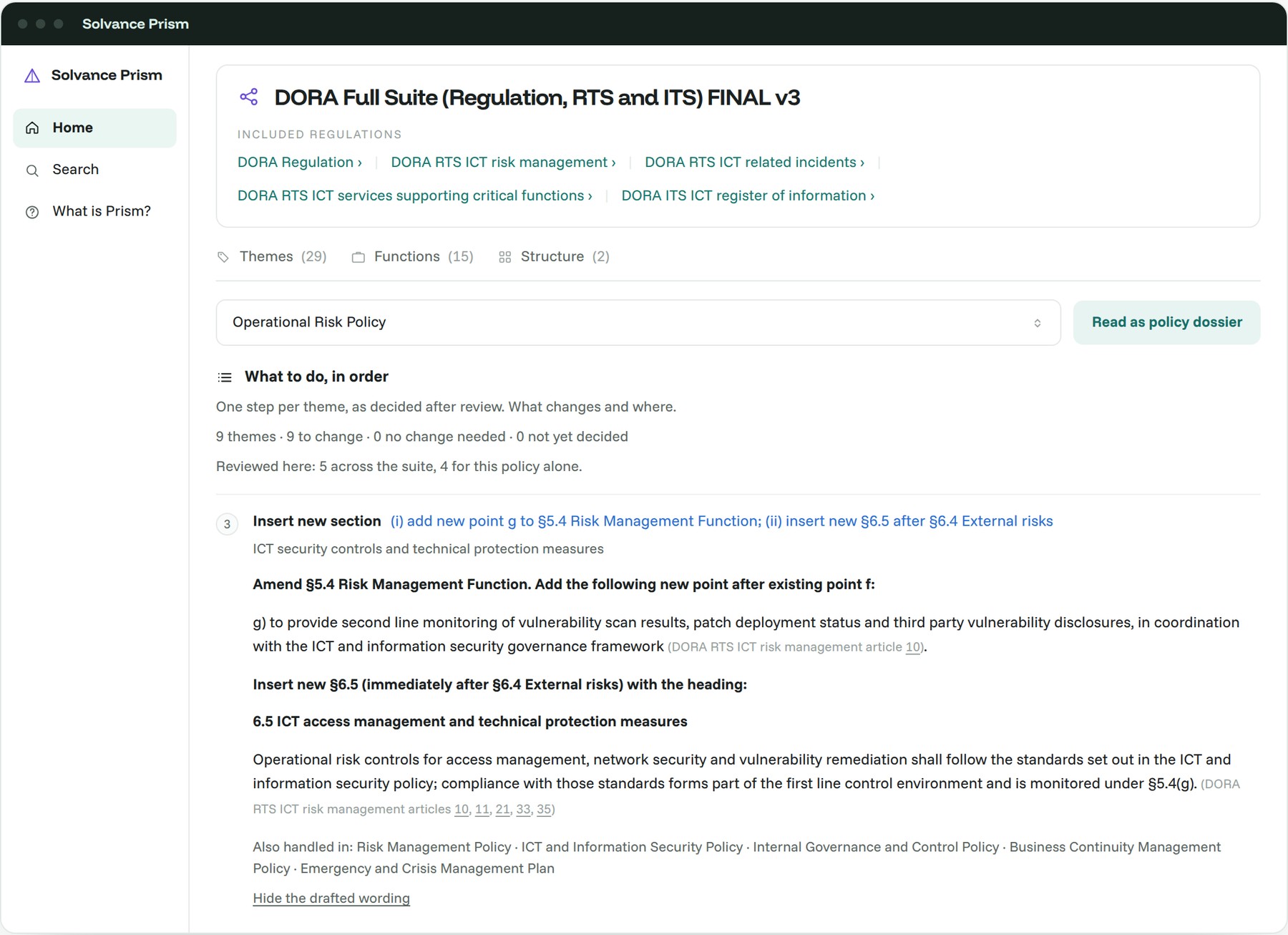
A DORA analysis produced 42 proposed policy changes. Here is one of them.
The drafted wording carries the article it rests on. The reasoning behind it is written down, and open to inspection the moment someone asks.
“Solvance has the potential to fundamentally transform that process. The most valuable aspect is the concrete proposed policy amendments, clear guidance on what is missing from our governance documents and what needs to be adjusted.”
Rosita Öhman-Qvist · Governance Manager @ Rentokil Försäkring AB
Solvance reads legacy text meaning by meaning, not keyword by keyword. A requirement is matched on what a passage actually commits you to, even when your document never uses the regulation's vocabulary.
A regulation does not land on a company, it lands on people. Each requirement is mapped to the roles that must carry it, so the work can be handed out instead of discussed.
The board gets its own, and so do the risk function, the actuarial function, IT and the data protection officer. Each one holds the obligations that reach that role, with the articles behind them.
Nobody has to read DORA end to end to find their part of it. The dossier is the part that applies to them, in the order it applies.
Where two roles both carry something, or where nobody does, it comes out as a finding rather than as a surprise. Solvency II asks for clear allocation and appropriate segregation, and this is where you evidence it.
Every article tested against every role and every policy. Three cadences keep it current.
When a framework is added or amended, and when one of your own policies changes.
Gaps, recommendations and board ready material on the cycle you already run.
Role dossiers, policy views and open search through LUMI.
The amendment published that Tuesday morning read, mapped to your obligations, and drafted against every policy in its blast radius before the coffee has gone cold. Not yet. That is the direction we are building in.
In 30 minutes we show you what a structured analysis of that regulation looks like for a company your size, from regulation text all the way to concrete policy amendments. If it is not better than what you have, you have lost half an hour.
Half an hour, on a regulation you are working on. No integration against your systems, and nothing to prepare.
The decisions are always yours, made by you and supported by the analysis.